
The Science
Science Built Into Every Shot.
A table tennis blade may look simple, but it is a mechanical system.
During the brief instant of contact, the blade bends, compresses, vibrates, absorbs energy, and returns energy to the ball. Those interactions determine much of what a player experiences as feel, touch, dwell, speed, spin, control, stability, and forgiveness.
The purpose of this project was to understand those interactions well enough to design a blade systematically—rather than discovering one through trial and error.
EXPLORE THE SCIENCE
A Blade Is a Complete System
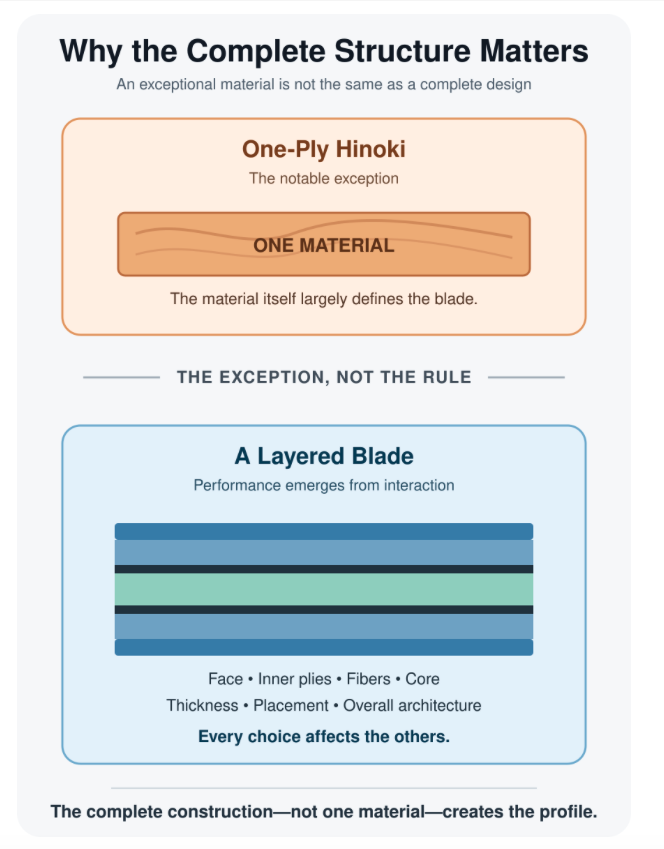
Most modern blades are layered structures whose playing characteristics emerge from the interaction of the entire construction.
A one-ply Hinoki blade is the notable exception. Because it is made from a single piece of wood, the material itself largely defines the blade.
In a layered blade, however, no single wood, fiber, or measurement determines how it plays.
Its character emerges from the interaction of:
The face wood
The inner plies
The core
The fibers
The thickness of every layer
The position of every material
A thin fiber placed near the surface behaves differently from the same fiber placed closer to the core. A soft face over a firmer interior behaves differently from either material alone. Thickness changes compliance, stability, forgiveness, and weight.
Every design choice affects the others.
That is why the complete construction must be evaluated as one system.
Twenty-One Playing Characteristics
Most blades are described with a few broad labels—fast, controlled, stiff, soft, offensive, or all-around.
That is not enough to explain how a blade actually plays.
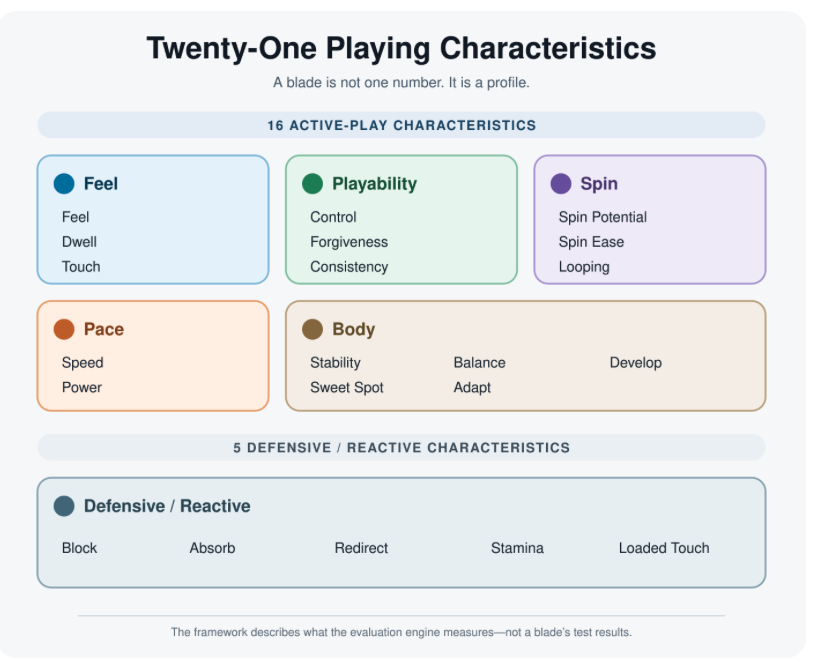
The evaluation system developed for this project describes every blade across twenty-one distinct playing characteristics.
The first sixteen describe active play—the shots where the player commits a stroke.
The final five describe defensive or reactive play—blocking, absorbing pace, redirecting the ball, and maintaining control under pressure.
Together they create a far more complete picture of how a blade performs—from the most delicate short touch to the hardest attacking shot.
A blade is not one number.
It is a profile.
The Physics Engine
The number of possible blade constructions is enormous.
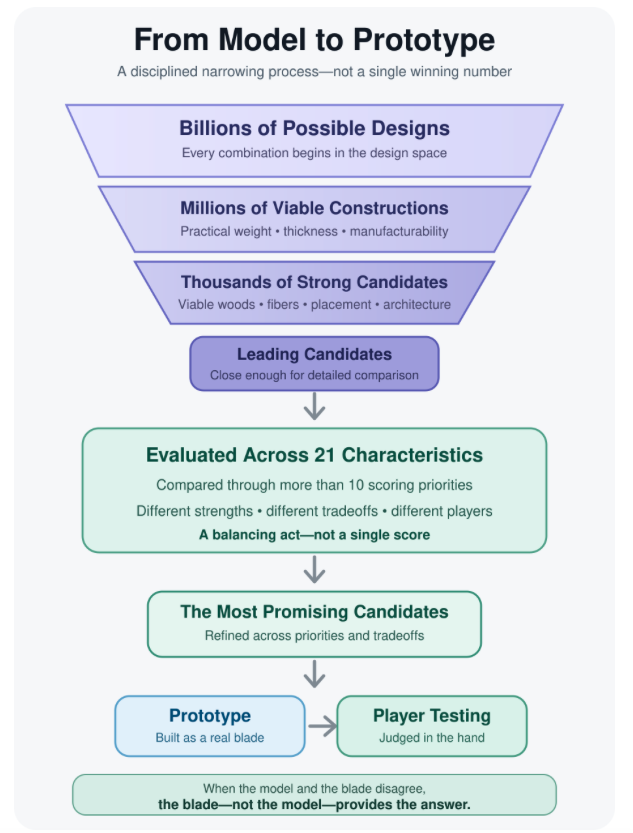
Changing the wood species, layer thicknesses, core material, fiber type, fiber placement, or overall architecture creates a different blade. The usable design space contains billions of possible constructions—far more than anyone could evaluate by building prototypes one at a time.
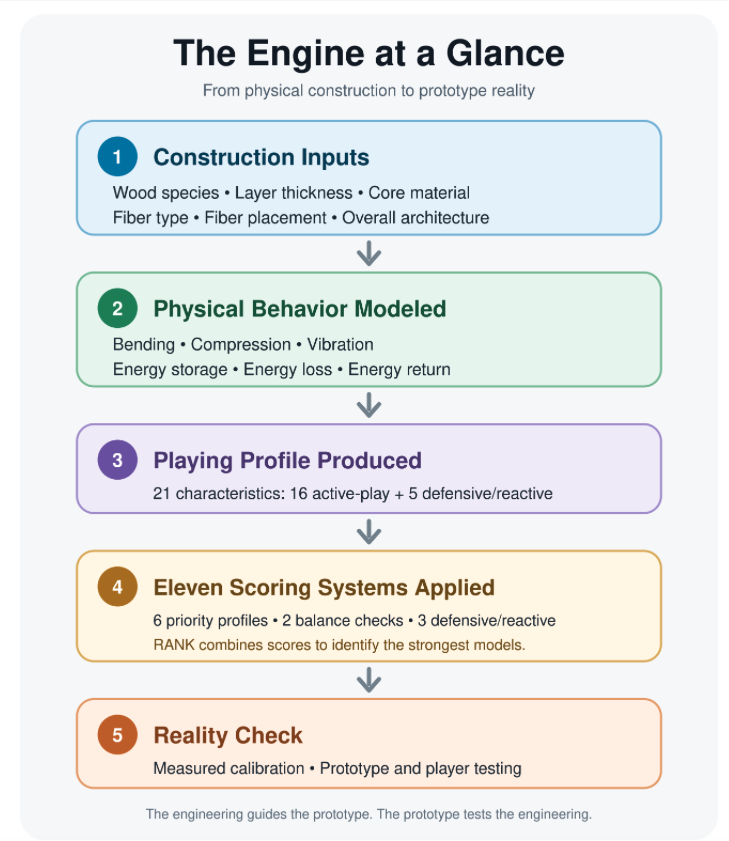
To explore that space, I built a physics-based evaluation engine.
The engine begins with the physical construction of the blade. It models how the structure bends, vibrates, stores energy, dissipates energy, and responds during contact. Those physical behaviors are then translated into the twenty-one playing characteristics.
The model was calibrated against a representative group of measured commercial blades before being used to evaluate new constructions.
The engine does not rely on one definition of the “best” blade. Each twenty-one-characteristic profile is evaluated through eleven scoring systems.
Six emphasize different combinations of feel, pace, control, completeness, and spin. Two reward balance by penalizing uneven profiles or rewarding a high floor. Three evaluate defensive and reactive play, including blocking, absorbing pace, redirecting, stamina, and loaded touch.
RANK combines scores to identify the strongest models for comparison.
The objective was never to find the highest score.
It was to understand the tradeoffs—and identify designs that remained strong across many different priorities.
Feel, Touch, and Dwell
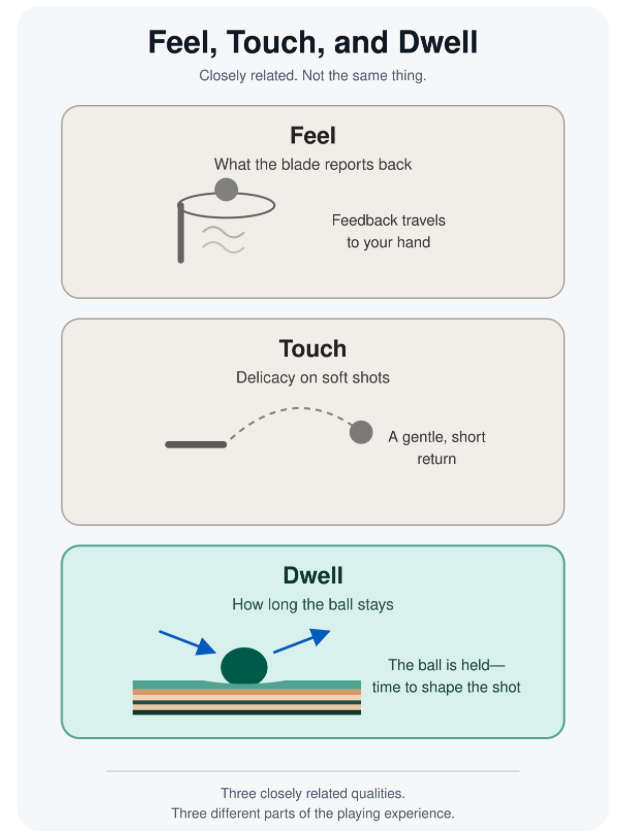
Feel, touch, and dwell are closely related.
They are not the same thing.
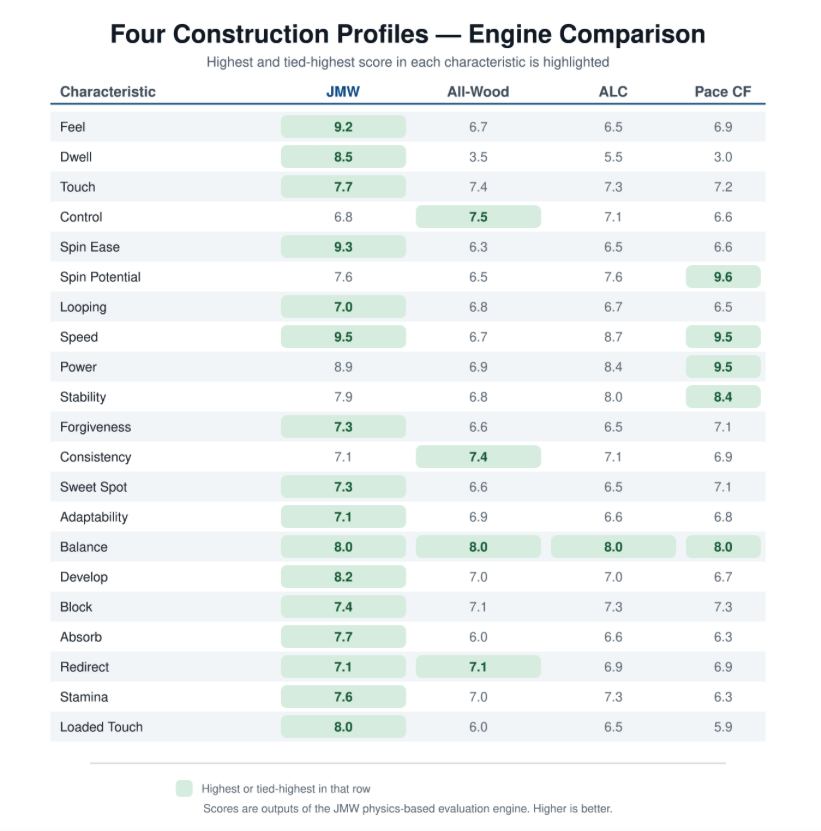
Feel is how clearly the blade reports the shot back to your hand through vibration, sound, and sensation.
Touch is precision during low-power shots—pushes, drop shots, short serves, and delicate returns.
Dwell is the brief time the ball remains in contact with the racket.
That contact lasts for only roughly a millisecond.
Yet that millisecond changes everything.
More dwell gives the rubber slightly more time to grip the ball, making spin feel easier and giving the player a greater sense of connection to the shot.
This became one of the project’s most important discoveries.
I began believing I was searching for greater feel.
Eventually I realized I was searching for something deeper.
I was searching for greater dwell.
Separating Two Different Jobs
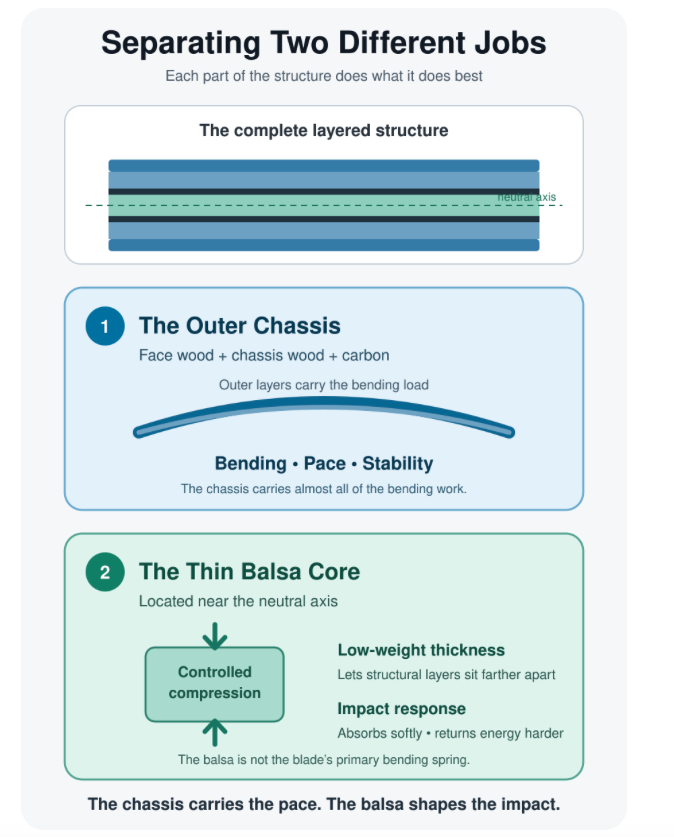
Balsa has been used in table tennis blades for decades, usually as a thick core that serves as the blade’s primary spring.
The architecture developed during this project uses it differently.
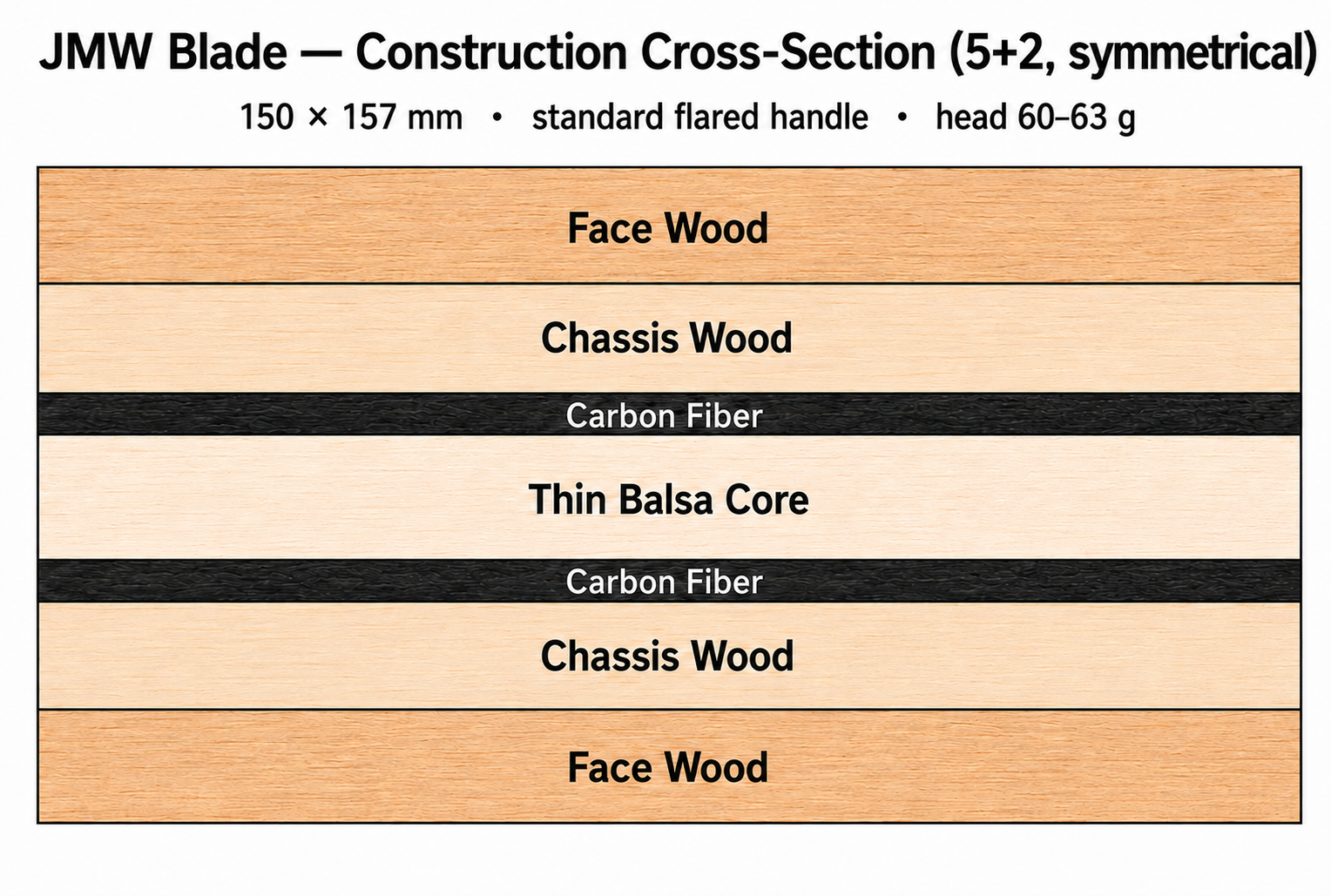
The thin balsa core sits near the neutral axis of the blade, where it contributes very little to bending stiffness. Instead, the outer woods, intermediate plies, and carbon form a structural chassis that carries almost all of the bending load.
The chassis carries the pace.
The balsa performs two different jobs.
First, because it is extraordinarily light, it allows the blade to become thicker without becoming excessively heavy. That extra thickness lets the structural layers sit farther apart, improving stiffness, stability, and forgiveness.
Second, the balsa contributes a controlled through-thickness compression response.
At softer impact it can absorb energy.
At greater impact it can return energy.
These are two different mechanical behaviors.
Separating them became one of the key engineering insights of the project.
Rather than asking one material to do everything, the design allows each material to do the job it performs best.
The outer chassis controls bending, pace, and stability.
The thin balsa core contributes a carefully controlled compression response.
The goal is not simply a balsa blade.
It is dwell with speed.
Why the Complete Structure Matters
The engine changed the way I thought about individual materials.
I began the project believing that Hinoki was necessary for exceptional feel.
Hinoki is an extraordinary blade wood.
Its softness and character can make it an exceptional face material.
But in a layered blade, even an exceptional face cannot determine performance by itself.
The layers beneath it determine how much the surface gives, how long the ball remains in contact, how the blade bends, how energy returns, and how stable the racket feels against incoming pace.
Every layer matters.
Every thickness matters.
Every material has a purpose.
The opportunity was never simply to find a better wood or a newer fiber.
It was to engineer how existing materials work together.
From Model to Prototype
[ Image placeholder: prototype / workshop photo ]A model is not the final authority.
The prototype is.
The engine identifies promising constructions, reveals their tradeoffs, and provides a disciplined reason for building one design rather than another.
But wood is a natural material.
Manufacturing introduces variation.
And some playing characteristics can only be understood when the blade is in a player’s hand.
The project therefore treats uncertainty openly.
Predictions become less certain as a design moves farther beyond the measured calibration data.
When weaknesses were discovered in the original engine, it was not patched to preserve earlier conclusions.
It was rebuilt from the ground up.
The resulting designs were then evaluated again under the new engine. Some ideas survived. Others changed. Better ideas emerged because the new model described contact more accurately.
The engineering guides the prototype.
The prototype tests the engineering.
And when the two disagree, the blade—not the model—provides the answer.
But One Question Remained
By this point, I believed I had taken the internal construction about as far as I could.
The architecture was doing what I had hoped. The prototypes were confirming the model. The blade felt the way I had been trying to make it feel.
But one question kept bothering me.
Almost every modern table tennis blade has essentially the same outline.
Some are slightly rounder.
Some are slightly squarer.
Then Stiga introduced the Cybershape, showing that players were willing to rethink blade geometry.
That led me to wonder:
If we can redesign the inside of the blade…
why are we still assuming the outside is already optimal?
That question became the next stage of the project.
Rethinking Blade Shape
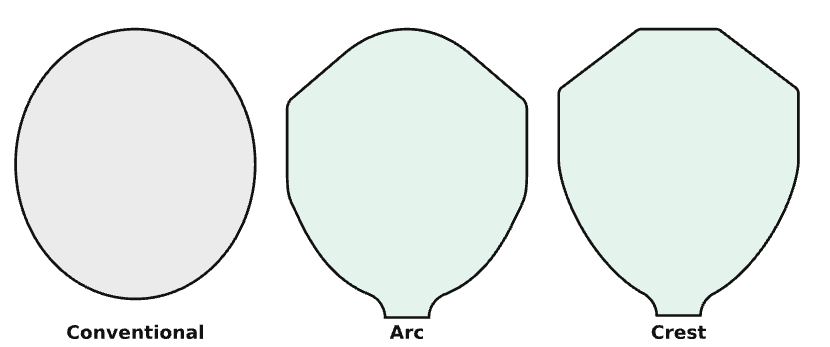
A Familiar Standard—and Two Alternatives
For roughly a century, the table tennis blade has been an oval. It is familiar, proven, and remains the shape most players know. JMW began with conventionally shaped blades, and they will remain part of the line.
But players don’t strike the ball evenly across the face. On loops, drives, and serves, contact tends to cluster in the upper-middle of the blade. A conventional oval reaches its full width near the bottom of that region and narrows steadily above it.
That raised a different question: could the same blade area be distributed differently—for players who want more width where contact happens most often?
Where the Ball Lands
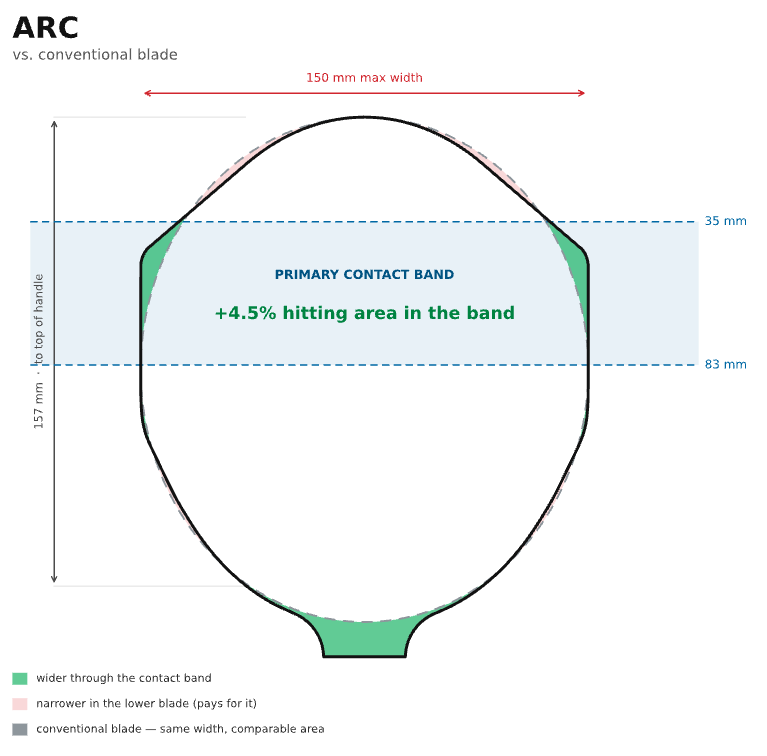
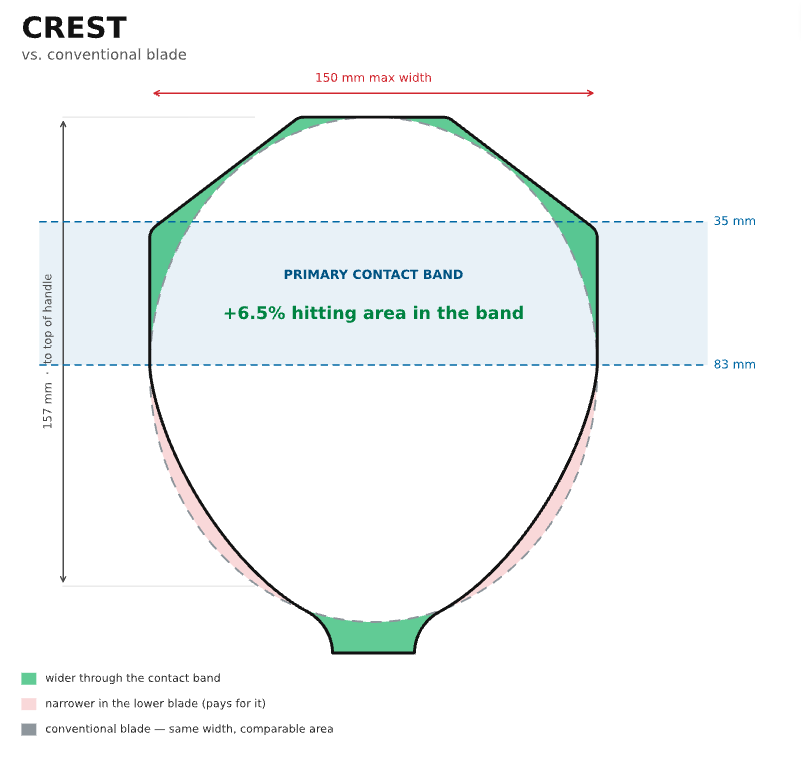
The primary contact band lies approximately 35 to 83 mm below the top edge—supported three independent ways: coaching analysis of loop and serve contact, wear patterns on elite players’ used blades, and a U.S. training-racket patent identifying the same target zone.
Different evidence, one answer: much of the game is played in the upper-middle of the blade.
That conclusion wasn’t ours alone. Developed with Sweden’s KTH Royal Institute of Technology, the Cybershape was based on the finding that the optimal hitting area lies in the upper half of the blade. It enlarged the hitting area there and reached the tournament level, showing that players would accept a blade that did not look round.
The Cybershape Carbon uses more total surface area than a regular blade, with its lightweight carbon construction helping offset the added area.
Our question was narrower:
Could that width be moved higher without materially increasing the blade’s total area?
Move the Area, Don’t Add It
Arc and Crest begin with the dimensions of a conventional blade:
A 150 mm maximum width
Total surface area comparable to conventional
A comparable target weight
Familiar overall dimensions and balance
What changes is where the area lives.
A conventional oval reaches full width only near the bottom of the contact band and narrows above it. Arc and Crest carry more width higher—through the 35–83 mm band—and let the lower blade, struck less frequently, taper inward to help pay for it.
Nothing comes free: the lower body gives up area to help pay for the gain in the contact band.
Two Shapes, One Principle
Arc—a rounded crown with a fuller lower body. It provides approximately 4.5% more area within the primary contact band than the conventional reference while remaining visually close to a traditional blade.
It is the more conservative redistribution.
Crest—a distinctive tri-crown that carries full width higher through the band. It provides approximately 6.5% more area within the band—the larger geometric gain and the bolder silhouette.
It gives up more area in the lower body.
Both use the same principle:
Move width out of the less frequently struck lower blade and into the band where contact occurs most often.
Three Shape Choices
The conventional shape remains available for players who prefer the geometry they already know.
Arc offers a moderate redistribution in a familiar-looking outline.
Crest offers the greatest contact-band gain and the most distinctive silhouette.
Arc and Crest are two additional ways to explore what blade geometry can do.
What We Claim—and What We Don’t
We don’t promise a “bigger sweet spot”—that depends on construction, vibration, stiffness, and feel, not shape alone.
We don’t claim that shape by itself creates more speed or spin.
What the geometry delivers can be measured:
The same 150 mm maximum width
Total area comparable to a conventional blade
Approximately 4.5% more contact-band area for Arc
Approximately 6.5% more contact-band area for Crest
The conventional blade remains the familiar standard.
Arc and Crest offer two alternatives: